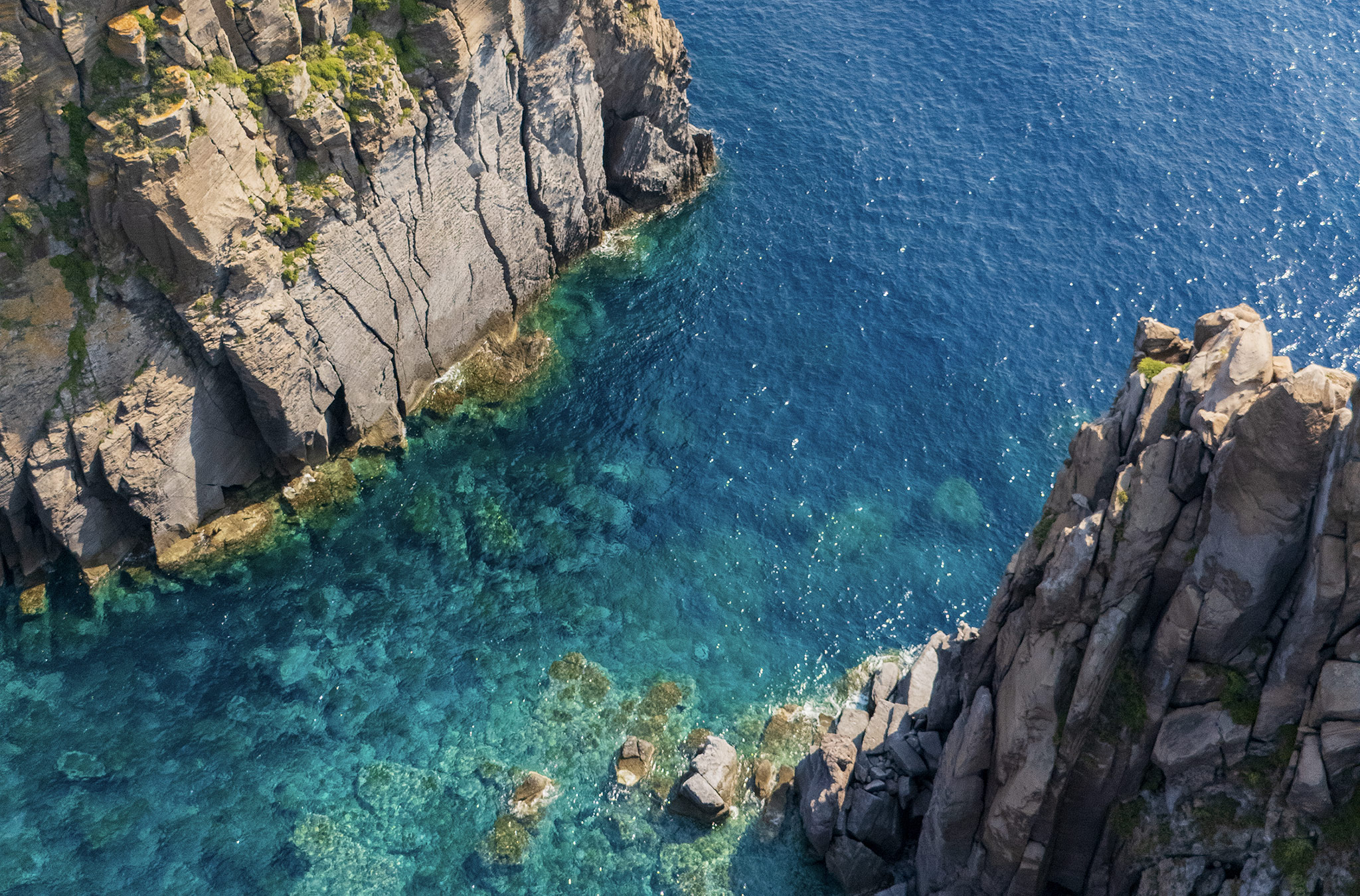
You don’t visit Panarea and Stromboli together by chance. You visit them together because that’s how it makes sense: spend the day in Panarea, which is small and beautiful and knows it, and the night beneath Stromboli, waiting for the volcanic eruptions and watching the glow that lights up the darkness. It’s probably the most spectacular trip you can take in the Aeolian Islands. Stromboli is one of those places that the darkness completely transforms.
Our journey


Panarea is the smallest and most popular of the Aeolian Islands during the summer months — but from the sea, far from the bars and terraces, you can see why everyone comes here. The coastline is rugged, the colours of the water change every hundred metres, and the seabed is among the most beautiful in the archipelago. Famous people come here to spend time on their boats. And they’re right to do so.
Cala Junco
Black obsidian rocks form a natural frame, with crystal-clear water reaching depths of up to ten meters, and a seabed that shifts from emerald green to turquoise to blue in just a few steps. The bay is shaped like a natural amphitheater—basalt walls enclose it on three sides, transforming it into something resembling a swimming pool, but with the real sea inside. The light reflects off the water in a way you don’t often see elsewhere, and depending on the time of day, everything changes: the colors, the shadows, even the sense of space.
The rocks of Basiluzzo
Just off Panarea, Basiluzzo is an uninhabited islet with a coastline of columnar basalt — the same geometric formation as the Giant’s Causeway, only here in the middle of the Mediterranean and with no one around. The seabed around it is superb for snorkelling: there are Roman amphorae on the seabed, remnants of an ancient trade route.
Dattilo and the smaller islets
Surrounding Panarea is a small archipelago within the archipelago — Lisca Bianca, Lisca Nera, Bottaro, Dattilo. We sail around them: technically, they are just rocks, but they have a breathtakingly dramatic presence. The water between the rocks takes on colours you can’t quite put a name to.
The underwater fumaroles of Bottaro
Among the islets, the seabed is geothermally active. You can see bubbles rising from the bottom, the water is slightly warmer in certain spots, and the surrounding environment has a strange, suspended quality. It’s one of the most unique places to snorkel in the entire Mediterranean.
It takes about thirty minutes to sail from Panarea to Stromboli. We make the trip at sunset—it’s not just a detail; it’s part of the experience. The sun sets as the silhouette of Stromboli looms larger before you. At a certain point, you begin to see the glow of the eruptions—at first barely perceptible, then increasingly distinct as it gets closer. It’s hard to describe without sounding exaggerated. We’re not exaggerating.
Stromboli erupts every day. It’s not something that happens once in a while—it’s continuous, regular, almost punctual. Every twenty or thirty minutes, the volcano’s summit spews lapilli and lava into the sky, and when it’s dark, you can see it all: the explosions, the orange glow illuminating the smoke, the light reflecting off the water. The Sciara del Fuoco—the lava channel that flows down the side of the volcano—becomes a scene that is hard to describe to anyone who hasn’t seen it.
You position yourself offshore from the Sciara del Fuoco, at a safe distance. Engine off. You wait. And then it happens.
The Scorching Slope
The north-western slope of Stromboli is one of the most otherworldly landscapes in Italy. A solidified lava flow that plunges 700 metres down to the sea – black, steep and devoid of any vegetation. At night, when the lava flows, the contrast with the darkness is stark. It is unlike anything you have ever seen.
Eruptions from the sea
From below, you can’t see the mouth of the crater, but you can see everything else — the flashes of light, the lapilli illuminating the sky, the dull rumble of the explosions muffled by the water. It is a spectacle in the truest sense of the word: something you look at and are left speechless by.
Strombolicchio
The basalt rock formation to the north of the island, with its lighthouse perched atop it. At night, with Stromboli blazing behind it, it has a cinematic quality. It’s the perfect ending.