Lipari and Vulcano are within sight of each other—you just have to look up. Yet they are completely different. Lipari boasts three thousand years of history, white pumice cliffs, and some of the most picturesque seabeds in the archipelago. Vulcano has its crater, fumaroles, sulfur mud, and that smell that warns you from afar that you’re arriving somewhere out of the ordinary. You can visit both in a single day, without rushing.
Our journey


Lipari is the capital of the Aeolian Islands — the largest, the most populous, and the one with the richest history. But like almost everything on the islands, the best part isn’t visible when you’re walking through the town centre. You can see it from the sea.
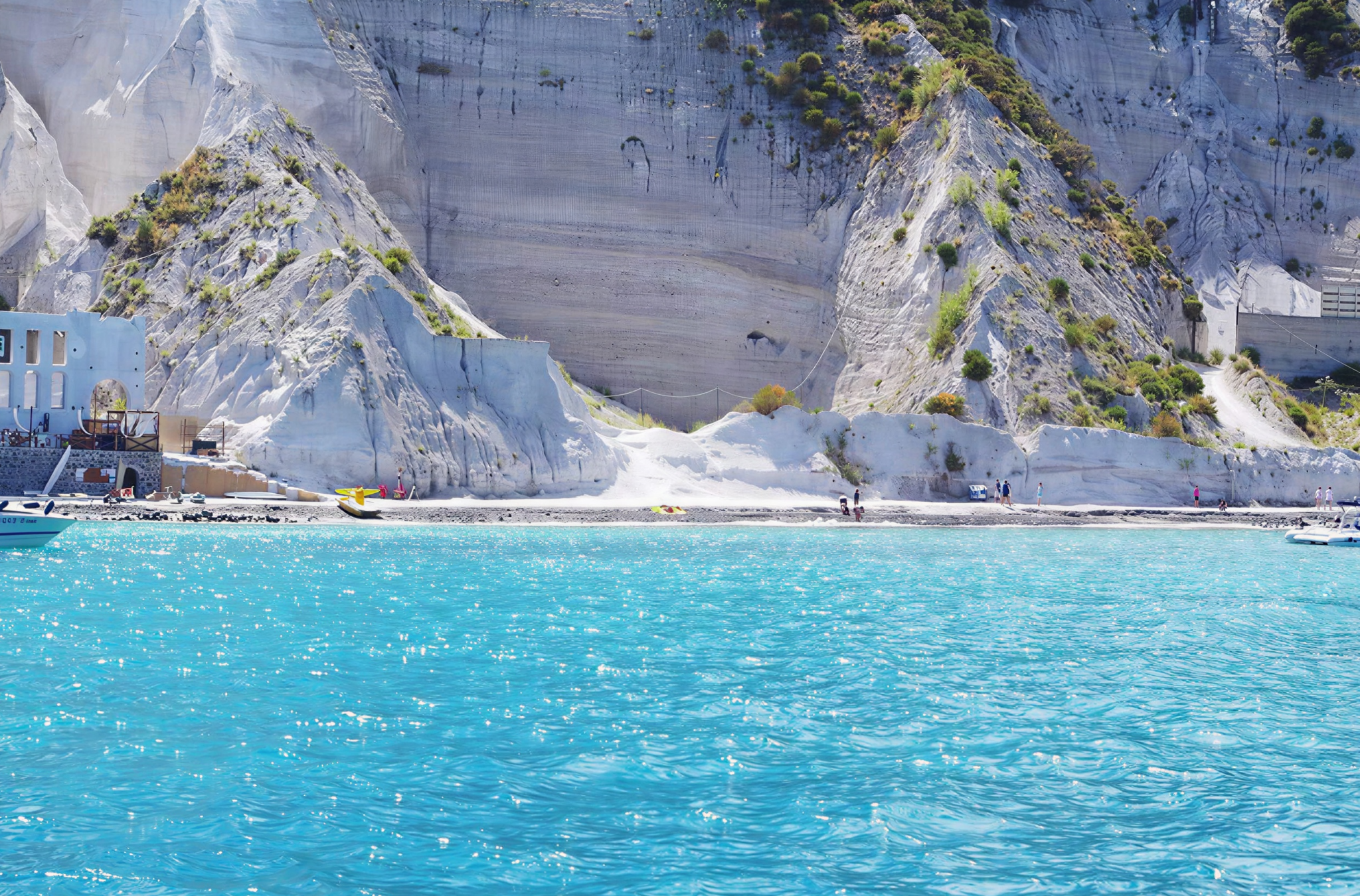
The pumice quarries at Porticello
The northern coast of Lipari is pure pumice — white, almost luminous, with the water below turning a milky turquoise colour due to the powder on the seabed. It is one of the most distinctive landscapes in the archipelago, and one of the best places to go for a swim. Pumice smooths the skin better than any scrub.
Four-eyed
Lipari’s most iconic viewpoint, which really comes into its own when viewed from the sea. The four rocks frame the silhouette of Vulcano in the background — the very same Vulcano we’re heading towards. Seeing it from here, before we arrive, has its own special meaning.
The west coast and the hidden coves
Hardly anyone ever sees the west side of Lipari. There are no roads, no houses, just black cliffs and coves that can only be reached by sea. We stop for a swim in one of these before heading towards Vulcano.
Vulcano announces its presence with its smell. The scent of sulphur reaches you before the island does — pungent, unmistakable, slightly unsettling. The island is active: fumaroles line the coast, steam rises from the rocks, and in some places the seabed is literally bubbling. This isn’t just folklore — it’s real geology, happening right now.
The Faraglioni of Levante
The east coast of Vulcano is a succession of rocky outcrops and arches of volcanic rock that change colour metre by metre — black, red, ochre yellow, pure sulphur. We sail close by: in some places the rock is still steaming, and the water around it is surprisingly warm.
Underwater fumaroles
Along the north coast, the seabed is geothermally active. Bubbles rise from the seabed, the water is warmer in certain spots, and swimming in it is a strange sensation that’s hard to describe. It’s unlike any other swim you’ve ever had.
The mud of Vulcano
The sulphurous mud pools are the island’s symbol. You dip in, wait, turn grey, and smell of sulphur for a few hours. The therapeutic properties of mud are well known, and the experience itself is unique. If you’d like to go ashore for a mud bath, we can arrange it.