Lipari and Salina, though very close to one another, seem to belong to two different worlds. Lipari is stone, pumice, and a history stretching back thousands of years — an island that has seen it all, and it shows. Salina is green, wind, Malvasia vineyards and a tranquillity you wouldn’t expect. Together they work perfectly: they complement and contrast with one another, and in a single day they give you a clear idea of what the Aeolian Islands are really like.
Our journey


Lipari is the largest and most vibrant island in the archipelago. It boasts three thousand years of history, a Norman castle and one of the most important archaeological museums in the Mediterranean. But what you can’t see from the mainland — the coastline, the quarries, the colours of the water — is the most beautiful part. You can only see that from here.
The pumice quarries of Porticello
The white cliffs of Lipari are made of pure pumice — one of the largest deposits in the world. From the sea, The northern coast of Lipari is pure pumice—white, almost luminous, with the water below turning a milky turquoise due to the powder on the seabed. It’s one of the most unique landscapes in the archipelago, and one of the best places to swim. Pumice smooths the skin better than any scrub.
Four-eyes
The most photographed viewpoint in the Aeolian Islands. From the sea, you can see the four rocks that frame the silhouette of Vulcano in the background — one of those landscapes that looks better from a boat than from any terrace.
The west coast
The west coast of Lipari is almost uninhabited. Black cliffs, hidden coves, a few fishing boats. We cruise along it at a leisurely pace before heading towards Salina — it’s the part of Lipari that tourists hardly ever see.
Salina is unlike any of the other Aeolian Islands. It’s green—truly green, not the dry, steppe-like landscape of its neighbors. Two dormant volcanoes, Malvasia vineyards, capers growing everywhere, and a coastline that changes its appearance every kilometer.
Pollara Bay
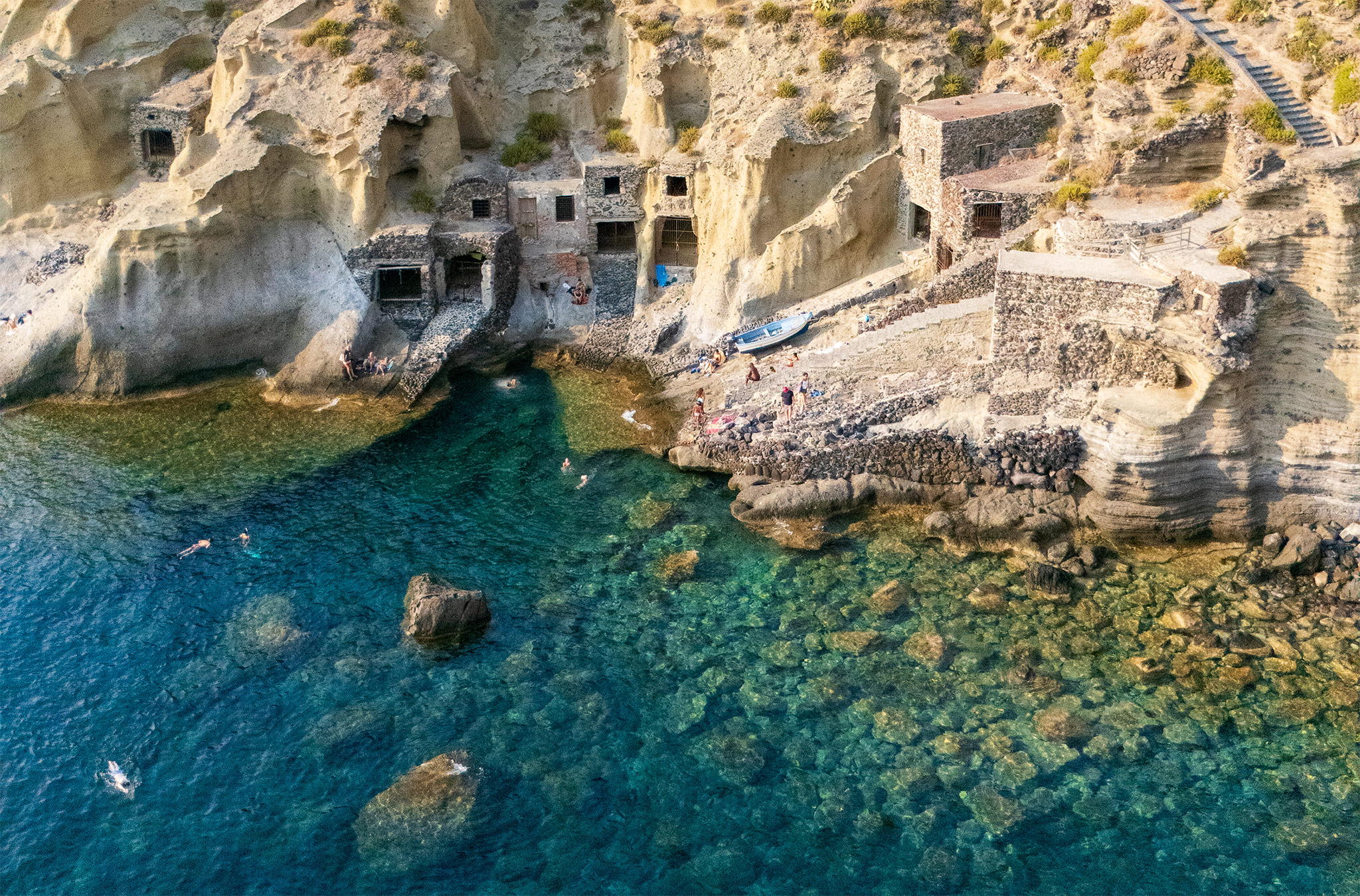
An amphitheatre of volcanic rock carved out by an ancient eruption, opening out onto the sea. It is the most beautiful spot on Salina and probably one of the most beautiful in the whole archipelago. We stop here for a swim: the seabed drops off steeply, the water is cold and crystal-clear, and the surrounding rock faces are quite impressive. If you’ve seen Il Postino, you already know what it’s like. It’s even better in real life.
Punta Perciato and the natural arches
A series of rock formations carved out by the sea over time — arches, tunnels, narrow passages. We sail right up close to them, keeping the engine at low revs. They’re the sort of things you won’t find in guidebooks, but which you’ll remember for years to come.