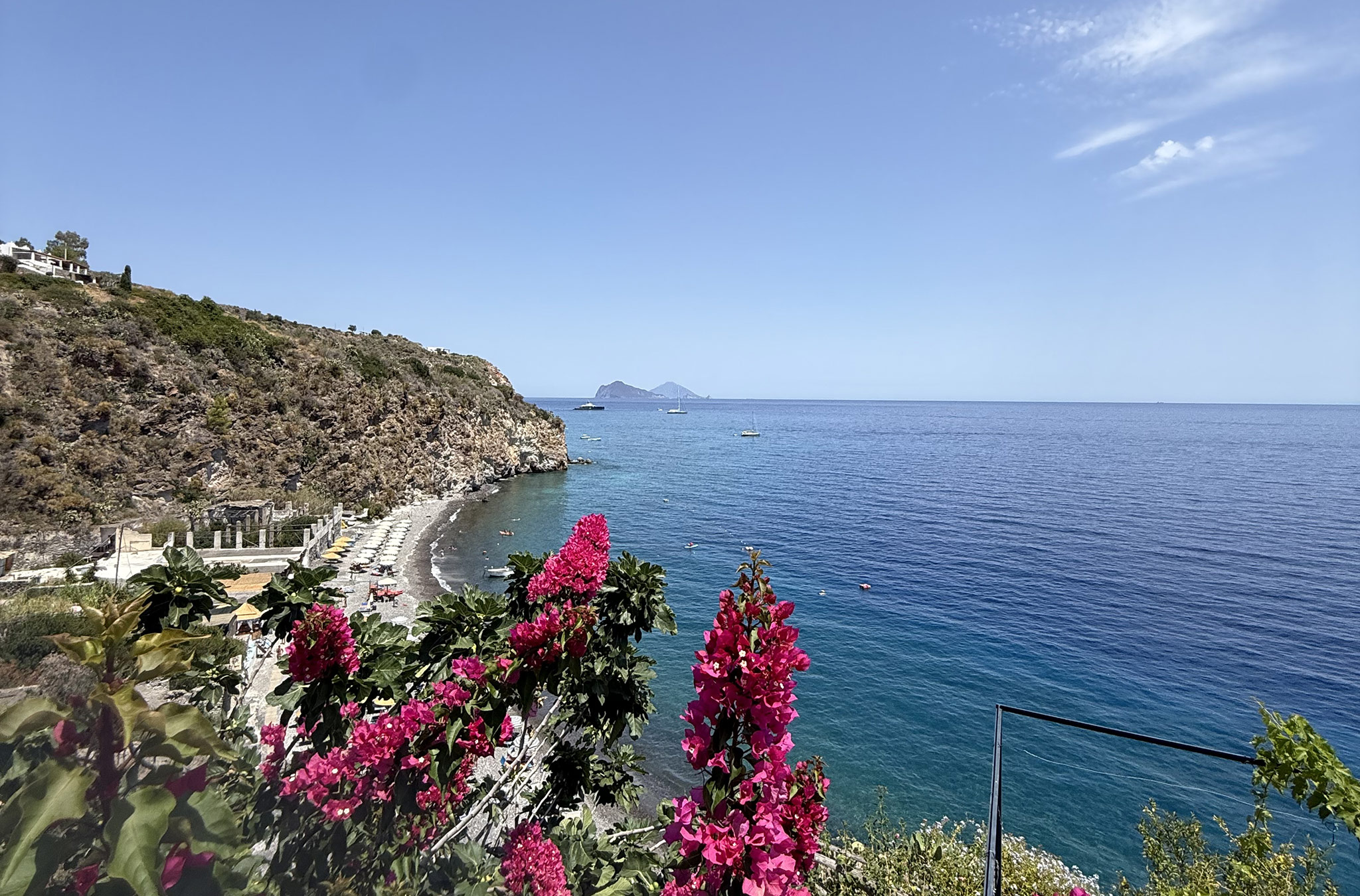
Three islands, three completely different worlds. Lipari is white rock and history; Salina is greenery, wind, and capers; Vulcano is sulfur, mud, and something vaguely mysterious. By boat, you can visit all three in a single day,
and when you return, you feel as though you’ve been on a real journey.
Our journey


Lipari is the largest and most vibrant island in the archipelago. It boasts a historic centre, a Norman castle and an archaeological museum that ranks among the most important in the Mediterranean for its collection on prehistoric marine life. But the most beautiful part can only be seen from a boat.
The pumice quarries of Porticello
The northern coast of Lipari is pure pumice—white, almost luminous, with the water below turning a milky turquoise due to the powder on the seabed. It’s one of the most unique landscapes in the archipelago, and one of the best places to swim. Pumice smooths the skin better than any scrub.
Punta Castagna and the east west
The west coast of Lipari is almost uninhabited. Black cliffs, coves, a few fishing boats. We cruise along it at a leisurely pace before heading towards Salina.
four-eyed
From the sea, you can see the most photographed viewpoint in the Aeolian Islands — four rocks framing the silhouette of Vulcano in the background. It’s one of those places that looks better from a boat than from land.
Salina is unlike any of the other Aeolian Islands. It is green — truly green, not the dry, steppe-like landscape of its neighbours. Two dormant volcanoes, Malvasia vineyards, capers growing everywhere, and a coastline that changes its appearance every kilometre.
Pollara Bay
It’s the most beautiful spot on Salina and probably one of the most beautiful in the archipelago. An amphitheatre of volcanic rock carved out by an ancient eruption, opening out onto the sea. People stop here for a swim — the seabed drops off steeply, the water is cold and crystal-clear, and the surrounding rock faces are quite impressive. If you’ve seen *Il Postino*, you already know what it’s like. It’s even better in real life.
Santa Marina and Malfa as seen from the sea
The two main villages on Salina are clearly visible from the boat: white houses, terraced vineyards, and a few churches. We don’t go ashore — we take in the island from the coast, which is the best way to get a sense of what it’s like.
You sense Vulcano before you see it. The smell of sulphur wafts in from afar – pungent, slightly acrid, unmistakable. The island is active, in the sense that it really is smoking: fumaroles along the coast, jets of steam, the Earth’s crust at work. It’s not a tourist cliché; it’s geology in real time.
The Faraglioni of Ponente
A series of rocks and natural arches on the west side — one of the most spectacular stretches of the Aeolian Islands. We sail right up close to them: the volcanic rock changes colour depending on the minerals it contains, ranging from black to ochre red to sulphur yellow. In some places, it is still smoking.
Underwater fumaroles
Along the island’s northern coast, the sea is bubbling — literally. Thermal water rises from the seabed and, in some places, the temperature rises noticeably. You can swim there, but you need to be careful where you go. It’s strange, it’s warm; it’s one of those places you don’t quite know how to describe to someone who hasn’t been there.
The mud of Vulcano
The sulphurous mud pools are the symbol of the island. You dip in, wait, turn grey, and stink of sulphur for a couple of hours. It’s not exactly elegant, but it works — the mud has recognised therapeutic properties and, above all, it’s an experience unlike any other. If you’d like to go ashore here, we can arrange it.
The Great Crater seen from below
From the sea, you can see the mouth of the volcano — the outline of the crater against the sky, the steam rising from the fumaroles. It’s one of those views that reminds you that you’re sailing through an active volcanic archipelago, not a picture-postcard seascape.