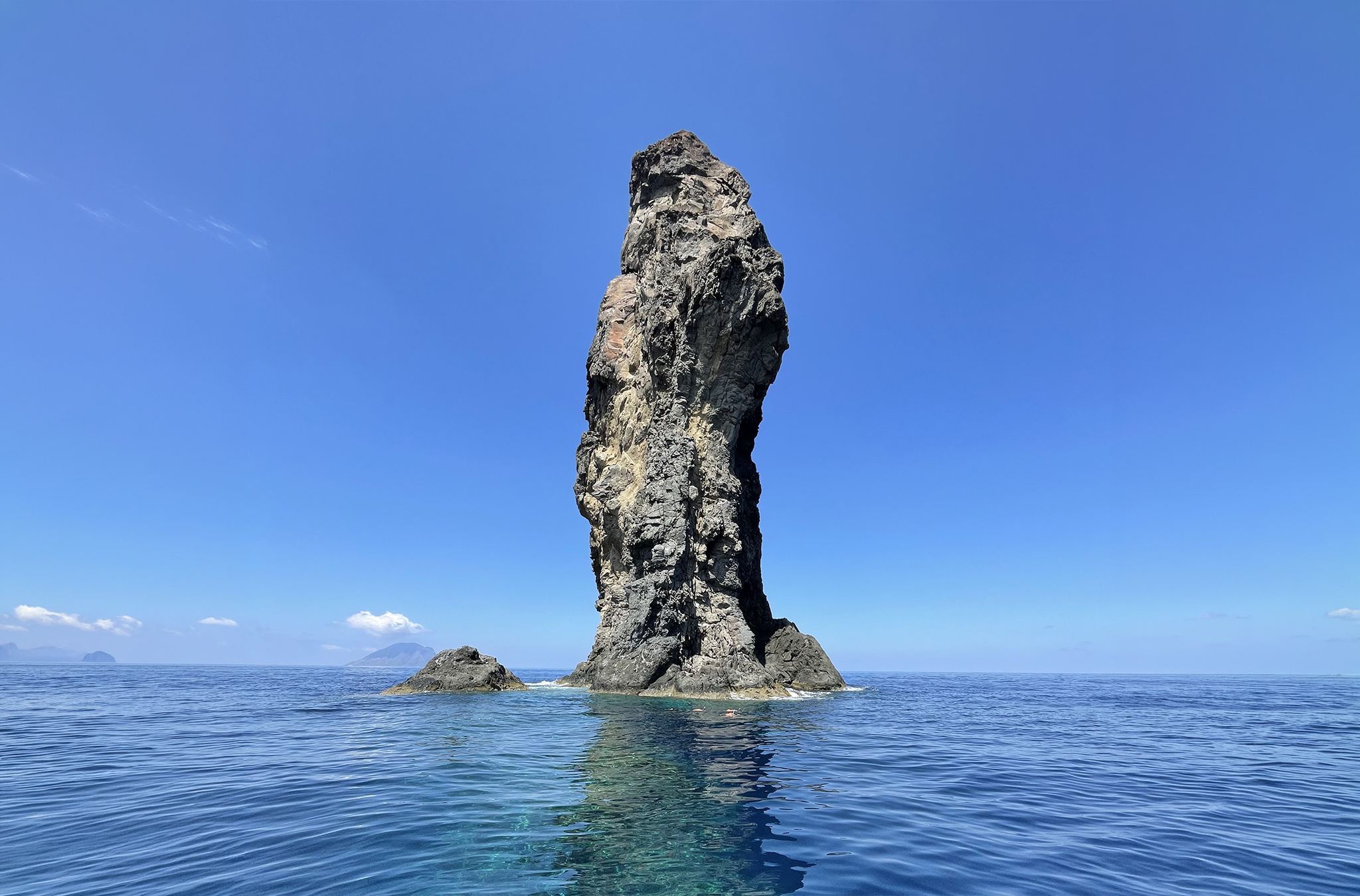
In the Aeolian archipelago, there are two islands that have said no. No to mass tourism, no to resorts, no to tarmac. Alicudi and Filicudi have remained exactly as they were fifty years ago — and will likely still be the same in another fifty years. This trip exists for one reason alone: to take you there, and leave you for a day in the place furthest from the world that you can reach by boat.
Our journey


Filicudi appears out of nowhere. It gives no warning; it simply emerges from the sea as a black silhouette. With fewer than three hundred residents, just a few streets, hardly any cars, and a coastline you’d never see from land, we take our time circling the entire island, stopping wherever it’s worth stopping.
The Canna
A volcanic rock obelisk rising seventy-one metres from the sea. It is the symbol of Filicudi and one of the most spectacular rock formations in the entire Mediterranean. Sailing past it is quite a sight: the black lava against the turquoise water, the silence broken only by the seagulls. It’s one of those things that doesn’t photograph well but you’ll never forget.
The Bue Marino Cave
It takes its name from the monk It is named after the monk seals—the “sea oxen”—that once lived here. Some also say the name comes from the sound of the sea inside the cave, which resembles the lowing of an ox. The cave opens up in the lava rock—it is the largest in the Aeolian Islands, twenty meters high and thirty meters wide—and inside, the water glows. You anchor outside and swim in, with the echo amplifying every drop, every wave against the walls. Even those who arrive in groups end up speaking in whispers.
Capo Graziano
On the headland lie the remains of a Bronze Age village, among the best-preserved in the Mediterranean. Three thousand years of history, shaped by lava and wind. The view of the archipelago from here is unobstructed — Salina, Lipari, and Stromboli, smoking away in the background as if it were the most natural thing in the world.
The coves of Pecorini by the sea
The harbour at Pecorini is one of the most unspoilt spots in the Aeolian Islands. A few fishing boats, a jetty, the smell of the sea. We stop here for a swim: a seabed of dark lava, crystal-clear water, fish going about their business. That strange, wonderful feeling of being truly alone.
Alicudi has no roads. It has no cars, no scooters, nothing with wheels. The only way to get around the island is via lava-stone stairways—thousands of steps carved by hand by the islanders, climbing steeply toward the roughly 120 remaining inhabitants. Supplies still arrive by mule. This is no romantic exaggeration: that’s exactly how it is.
Seen from the sea, it has the shape of an almost perfect cone—there are no bays, no inlets, only high, jagged cliffs that drop straight into the water. You disembark at the port, stroll among the steps and the white houses clinging to the rock, and then you set off again.
Galera Rock
On the western side of Alicudi, a rock rises out of the sea that the locals call “the submarine.” It has the perfect shape—a dark, elongated silhouette that breaks the surface, as if it were about to sink. Up close, the lava rock appears scaly and jagged, and the water around it shifts in color in such a way that it’s hard not to stop and look.